
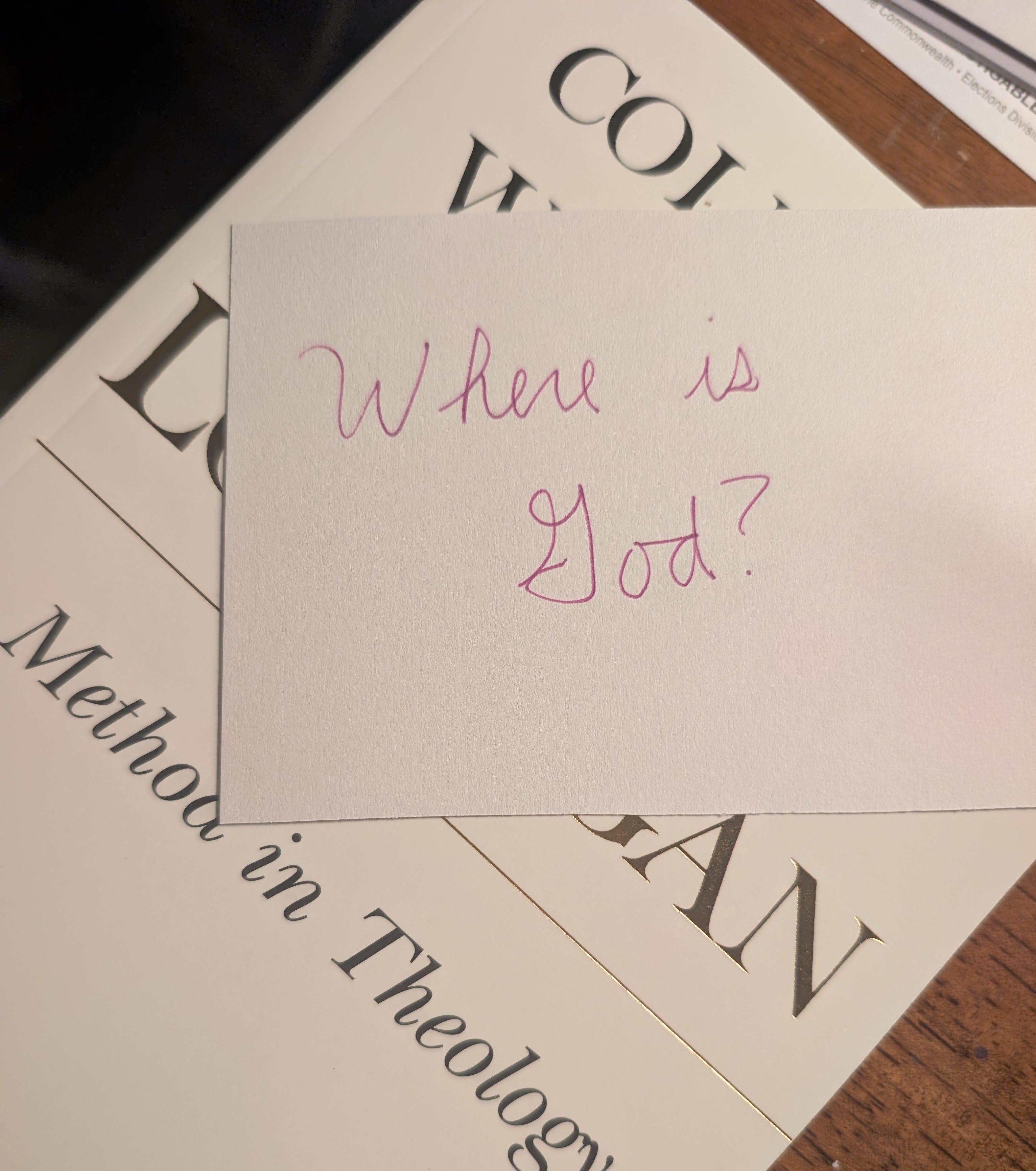
Pick a word. No, not any word. A question word. Yes, one of those. A who/what/when/where/why/how. Those are my friends.1 Those little words that crack open meaning, that delve into understanding.
A good question can shift everything.
Which I knew, but yet, somehow, didn’t yet know. I wrote my first round of grad school applications (to seminary and the MDiv) all about questions. “I believe we find God in our questions: I want to ask those questions at [seminary].” Through six rounds of personal statements and essays, I wrote those words. We find God in our questions. But I think it fully took me my whole first master’s degree to realize what that meant.
We find God in our questions.
It sounds good. It sure does. But what is the meaning behind the statement, or even the question hidden within these words?
I am now in my second master’s degree. This one, also theological, is more academic. More research-focused. One could say it is even more question-driven. And that has certainly been the case in 3 out of 4 classes, where our main CFU (Check for Understanding) assignment is to write a question based on that week’s readings. In one class I turn these questions in written on an index card, old-school. In another they are turned in on a PDF, emailed to the professor. And in yet another, I submit them as a “reading blog” on a forum. Regardless of the format, all these classes are encouraging me to ask expansive, responsive questions that dig deep into the subject matter that we are exploring, whether that be trans issues, racism, or theology itself.
The advice I have been given by professors when asking questions is to “sharpen” them. Although I have not asked explicitly what they mean, what I surmise is that you should know the purpose of your question, and make the likelihood of answering it match that purpose. To sharpen a question is to focus it to its audience and setting.
What if we sharpen the questions we ask of each other, of our communities, of our institutions and societies? What would we find then?
I am remain convinced that not every question has an answer. But of this I am sure: In the space between the question and the answer, the space between what we know and what we don’t, that is where we find God. God is in the mystery, in the liminal, the not-sure and the tentative. These are not the only places God lives, but these are the places I know I will find Her.
In a recent class session of a course I am taking with womanist ethicist emilie m. townes,2 we brought in our questions for the day. One of the questions that was raised left affective traces of defeat in the air, and Dr. Townes noted this as we wrapped our discussion. The room felt heavy and low. In affect theory we might say that the affect present was sticky, or contagious.
Questions have power. They have the power to shift things, whether it is affect or structures or the thinking of any number of people. Including just you.
Questions can make change. Or at least start it.
With God living in the in between of questions, and in the change they create (amongst other places), I have confidence that I (and maybe you, as well) can question your way to the Divine, regardless of what authorities and hierarchies and systems of domination have to say.
note, other words are also my friends.
y’all it is all i can do in each class not to fangirl out of my tiny chair/desk that i am taking a class with her.
Beautiful🙏🏻
Maybe every question, sincere or not, is rooted in fear:the fear of not knowing and worse the fear that I can never be safe from that experience. Then how does that experience arise? Could it be simply that my first experience with "the other" reveals powerfully that it is separate, and distinctly beyond my inner reach. My senses perform as hearing and so on...giving me a sense controllable reality. Internally, however I am sometimes an emotional, or worse, an intellectual mess as well and cannot be counted on. So I ask about God and run into the same confusion that accepting as real the experience that separateness brings.
So why not study fear, my fear? Can I do that by labeling and making it separate and therefore unknowable?